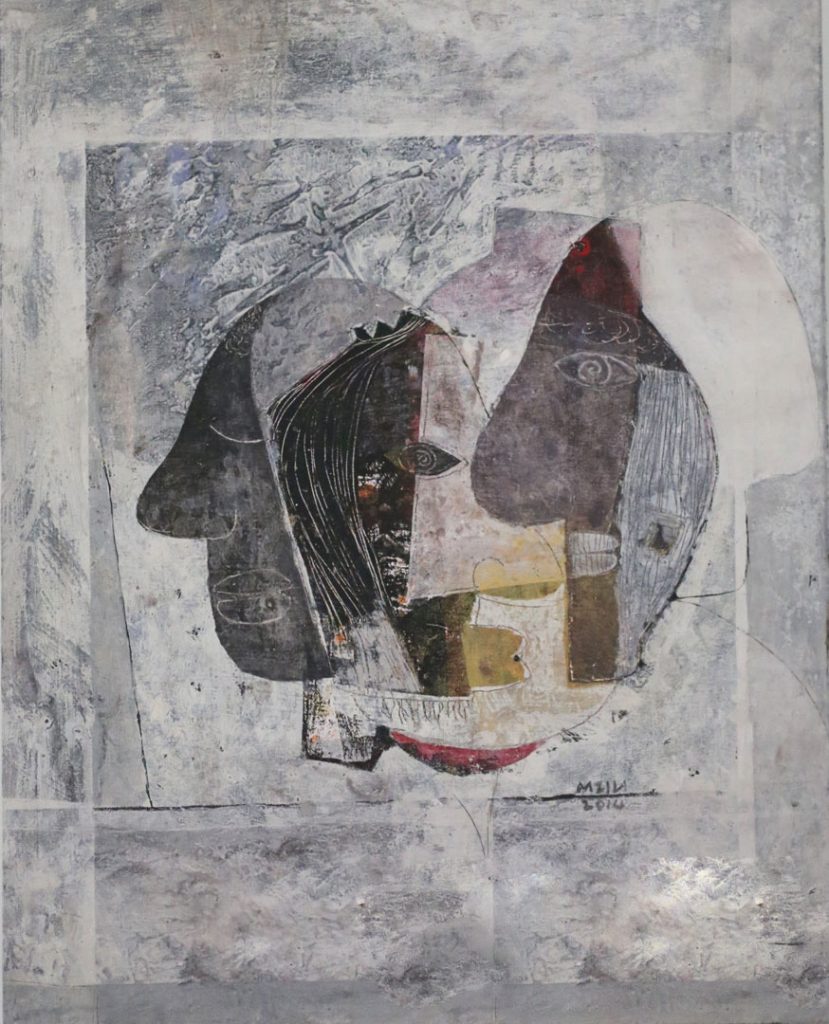
Henry Mzili Mujunga was born in 1971 in Uganda. He is a painter, printmaker and writer. In 1996 he graduated from Margaret Trowell School of Industrial Fine Art (MTSIFA) of Makerere University. He is also a holder of a Postgraduate Diploma in Education of the same University.
He has been exploring ways of reviving African art through an art movement called indigenous expressionism. He strongly advocates the importance of networking amongst contemporary African artists in order to share their culture and create an interesting dialogue with the art being produced globally.
Mzili’s works reference his immediate environment (both natural and man-made) to construct scenarios of heroism that seek to champion human strength and empathy. Mzili’s works feature numerous, seemingly disparate objects brought together into a single frame. They are set in intimate spaces where highly personal interactions take place – often combining several such spaces into one – with titles that describe the interactions within the paintings themselves, and at the same time allude to external associations.
Mzili’s gathering of objects, spaces, and the existing associations with these objects mimics the processes of identity-making that he observes in his native Uganda. Individuals often rely on their outward appearance, their possessions, even their environments to communicate their own vision of themselves. At the same time, these very things are looked upon by others to identify those around them. Ultimately, through these information-packed autobiographical compositions, Mzili is interested in ‘awing’ and ‘pleasuring’ through color and subject.
Mzili is a member of the Pan African Circle of Artists (PACA) that links artists working for the integration of Africa through art. He is cofounder of Kampala Arts Trust and Online Visual arts Journal Start Journal of Arts and Culture. He is the first curator of the Kampala Art Biennale, 2014.
Mzili is a winner of the Royal Overseas League (ROSL) Art Scholarship 2003 and has exhibited in galleries in Uganda, Kenya, Tanzania, Nigeria, Togo, Benin, Burkina Faso, Mali, Ghana, the United Kingdom, Germany, France, South Africa and the Netherlands.